Global buyers need storage systems that fit real operations, not attractive drawings alone. Adjustable Pallet Racking remains one of the most adaptable choices for warehouses handling mixed loads, changing inventory, and varied pallet sizes. Its beam levels can be repositioned, aisle layouts can be refined, and damaged components can often be replaced without rebuilding the entire installation.
Warehouse scholar John J. Bartholdi III describes the core purpose clearly: “The objective of a warehouse is to provide the right product, in the right quantity, at the right time.” This principle gives Adjustable Pallet Racking a practical advantage. A well-designed system can place fast-moving cartons near dispatch doors, while slower stock stays in higher or less accessible positions. Forklift clearance, load capacity, floor quality, seismic exposure, and local safety standards still require careful review. One layout cannot suit every country.
The seven systems examined in this guide reflect different operating realities. Some prioritize high density. Others protect access and picking speed. Selective racking may serve broad product ranges, while double-deep, drive-in, push-back, pallet flow, and mobile designs address more specific needs. Details matter. A 100-millimeter clearance error can affect forklift movement and pallet stability.
Buyers should also question supplier claims. Is the stated capacity based on tested conditions? Are installation drawings complete? Can replacement beams arrive quickly? These questions are easy to overlook. They should not be.
This guide compares the strongest options for global buyers, while recognizing an uncomfortable truth: the cheapest rack may become the most expensive decision when poor planning disrupts daily warehouse work.
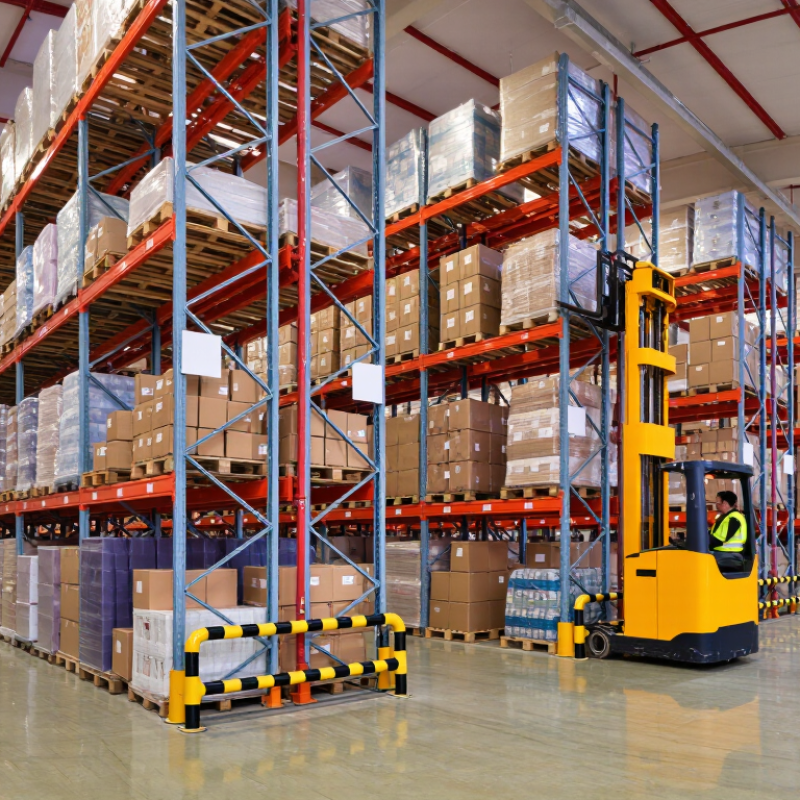
Seven Adjustable Pallet Racking Systems Compared by Load, Density, and Access
The seven strongest adjustable pallet racking options differ mainly in load, density, and access.
Selective racking offers direct access to every pallet and suits mixed stock.
Double-deep racking increases density, but forklifts need reach equipment.
Drive-in racking stores more pallets with fewer aisles, although access becomes limited.
Push-back racking improves storage depth and supports last-in, first-out handling.
Pallet-flow racking supports first-in, first-out rotation and high order frequency.
Mobile racking uses movable aisles for exceptional density, but movement adds operational complexity.
Very-narrow-aisle racking combines high density with strong selectivity, requiring specialized trucks and careful floor control.
Load capacity must come from engineered beam, frame, and anchoring calculations.
ANSI/RMI MH16.1 guidance stresses that rated capacity depends on the complete rack configuration, not one beam label.
The 2024 MHI Annual Industry Report places current robotics and automation adoption near 23%, with adoption expected to reach about 50% within five years.
That trend favors shuttle and mobile systems in labor-constrained facilities.
Still, automation does not repair poor slotting.
The 2024 State of Logistics Report estimated United States business logistics costs at
2.3 trillion dollars in 2023, or 8.7% of GDP.
Space and handling decisions matter.
Selective racks may waste cubic volume, while drive-in racks can slow retrieval.
A spreadsheet can still lie.
Real aisle width, pallet variation, fire protection, and operator behavior can change the result.
The best choice is often a compromise, not the densest layout.
Selective Racking: 100% SKU Access and Typical 1,000–5,000 kg Beam Loads
Selective pallet racking remains a practical choice for global warehouses because every pallet position is directly accessible. That access supports mixed SKUs, frequent picking, and clear stock rotation. MHI’s 2024 Annual Industry Report identifies inventory visibility and warehouse productivity as continuing priorities for supply-chain operators. Selective racks address both, but only when locations are accurately labelled and inspected.
Typical beam capacities range from 1,000 to 5,000 kg per level, depending on span, steel profile, load distribution, and frame height. These figures are not universal ratings. Buyers should request calculations based on actual pallet weights, dimensions, and forklift impacts. ANSI MH16.1-2023, published by the Rack Manufacturers Institute, provides engineering guidance for industrial steel storage racks. Load plaques should match the approved design.
Details matter. A 1,200 kg pallet may require two evenly loaded beams, sound timber, and sufficient pallet overhang clearance. Narrow aisles can improve storage density, yet they may slow forklift movements. That trade-off is easy to underestimate. Warehouse audits also find damaged uprights, missing safety pins, and overloaded beam levels. These are operational failures, not merely equipment problems. Selective racking offers excellent SKU access, but its performance depends on disciplined installation, inspection, and daily loading practices.
Selective Pallet Racking: Typical Beam Loads and SKU Access
Selective racking is designed to provide direct access to 100% of stored SKUs. Typical beam-pair load specifications range from approximately 1,000 to 5,000 kg, depending on bay width, beam profile, upright capacity, load distribution, and local safety requirements.
Illustrative industry load classes: confirm the final safe working load with a qualified rack engineer and the applicable local standard.
Drive-In, Double-Deep, and Push-Back: 2–6 Pallet Positions per Lane
Adjustable pallet racking must match product flow, building limits, and loading equipment. Drive-in racking provides dense storage, often with four to six pallet positions per lane. It suits uniform products moving in batches, but it usually operates on a last-in, first-out basis. Double-deep racking places two pallets behind each other. It commonly creates two to four positions per lane and needs reach equipment with suitable fork extension. Push-back racking typically offers two to six positions per lane, using nested carts and gravity movement. It improves selectivity while preserving strong density.
The 2024 MHI Annual Industry Report indicates that 55% of surveyed supply-chain organizations already use warehouse management systems. That figure is expected to reach 83% within five years. Racking decisions now need reliable location data, not only steel capacity. The U.S. Rack Manufacturers Institute’s ANSI MH16.1 standard also stresses structural design, load rating, and competent installation. Check pallet weight, beam deflection, floor strength, seismic exposure, and clearances before ordering. A neat layout can still be wrong. In site reviews, operators sometimes choose six-deep lanes, then discover poor access during seasonal demand. That mistake is expensive.
Global buyers should compare lane depth, pallet dimensions, forklift turning space, and local safety requirements. Drive-in maximizes density. Double-deep balances density and access. Push-back handles mixed batches more gracefully. The best adjustable system is rarely the deepest one; it is the one that keeps every stored pallet reachable, traceable, and safely supported.
Global Compliance: EN 15635, RMI Standards, and Seismic Design Factors
Choosing among seven adjustable pallet racking systems requires more than comparing capacity and aisle width. Global buyers should verify EN 15635 for installation, use, inspection, and maintenance controls. The standard expects systematic inspections, with expert inspection performed at least every 12 months. Daily checks should still record bent frames, missing anchors, and displaced beams. Small damage can become a serious stability issue.
RMI’s ANSI MH16.1 standard provides engineering guidance for steel pallet rack design in North America. It addresses frame strength, beam connections, anchorage, and load combinations. Buyers should request signed calculations, material grades, and connection details. A supplier’s catalog rating is not enough. Field conditions change the result. Concrete thickness, slab joints, forklift impact, and pallet quality all matter.
Seismic design needs separate attention. The USGS 2023 National Seismic Hazard Model indicates that nearly 75% of the United States could experience damaging earthquake shaking. FEMA seismic provisions commonly reference hazards based on a 2% probability of exceedance in 50 years. Local codes may demand different factors. EN 15635, RMI guidance, and regional seismic rules should be reviewed together, not treated as interchangeable. A double-deep or mobile system may save space, yet increase anchorage or operational demands. This is where planning can become imperfect. Initial layouts often ignore future load changes, uneven floors, or emergency access. Independent engineering review remains worthwhile, especially for high-bay storage and export projects.
Buyer Scorecard: Aisle Width, Storage Density, Safety, and Total Cost
A practical buyer scorecard should compare seven adjustable systems: selective, double-deep, drive-in, push-back, pallet-flow, very-narrow-aisle, and mobile racking. Selective racking offers the clearest access, while mobile racking can release floor space without changing the building. Double-deep and push-back designs increase density, but they reduce immediate pallet visibility. Drive-in suits stable, high-volume stock. Pallet-flow supports faster rotation. Very-narrow-aisle layouts require compatible handling equipment and disciplined operators.
Aisle width must match the truck, load, and turning path, not a catalogue promise. RMI MH16.1 guidance stresses engineered clearances, load data, and protection against impact. OSHA 1910.176(b) also requires safe clearance in aisles and passageways. Measure the real pallet overhang. Then test the turning radius with a loaded vehicle. Small errors become expensive. Density should be calculated as usable pallet positions divided by warehouse floor area. It should not ignore access loss, fire protection, or damaged locations.
Safety and total cost deserve equal weight. The MHI 2024 Annual Industry Report found that 55% of respondents expected AI adoption within five years, yet automation cannot repair weak rack inspections or poor slotting. Include anchors, guards, inspections, training, maintenance, energy, and future reconfiguration in the cost model. A cheaper frame may require more labor or create slower picking. A spreadsheet can still lie. Review three months of order history, seasonal peaks, pallet weights, and local engineering requirements before selecting the highest-scoring system.
FAQS
Selective racking provides direct access to every pallet position. It suits mixed products, frequent picking, and varied stock rotation. Access is excellent. However, it may use more floor space than denser systems.
Typical beam loads range from 1,000 to 5,000 kilograms per level. Actual capacity depends on span, steel profile, frame height, and load distribution. A 1,200-kilogram pallet needs even support and safe clearance. Never rely on one catalog number.
Double-deep racking places pallets behind other pallets. It reduces aisle space and increases storage depth. Reach equipment is required. Access becomes less immediate, especially for mixed products.
Drive-in racking stores many pallets with fewer aisles. It works best with uniform products and predictable movement. Retrieval can slow down. Direct access is limited.
Push-back racking supports deeper storage and usually follows last-in, first-out handling. Pallet-flow racking uses gravity lanes and supports first-in, first-out rotation. Flow systems suit frequent order activity. They require careful loading control.
Mobile racking can create very high density by moving storage aisles. Very-narrow-aisle systems combine density with strong pallet selectivity. Both need precise floor conditions and trained operators. Complexity increases.
Engineers should calculate the complete configuration, including beams, frames, anchors, pallets, and forklift forces. Rated capacity depends on the whole structure. Load plaques should match approved calculations. A label alone proves little.
Workers should check bent frames, missing anchors, displaced beams, and damaged safety pins daily. Formal expert inspections should occur at least every twelve months. Small damage matters. Records should identify location, date, and corrective action.
Local seismic rules may require stronger anchorage and different structural calculations. Floor thickness, slab joints, and building movement also matter. Nearly three quarters of one country may experience damaging shaking. Future loads are easy to underestimate.
Automation can support shuttle or mobile systems when labor is limited. It does not fix poor slotting, weak labeling, or bad pallet data. A spreadsheet can still lie. Real aisle width and operator behavior decide performance.
Conclusion
Choosing the right Adjustable Pallet Racking system depends on the balance between load capacity, storage density, product variety, and accessibility. Selective racking is the most flexible option, providing direct access to every SKU and commonly supporting beam loads of approximately 1,000–5,000 kg. For higher-density operations, drive-in, double-deep, and push-back systems can provide two to six pallet positions per lane, although they may reduce immediate access and require more careful inventory planning.
Global buyers should also evaluate compliance, installation quality, and site conditions. Designs may need to align with EN 15635, RMI-based safety principles, and local seismic requirements. A practical buyer scorecard should compare aisle width, usable storage density, forklift compatibility, inspection needs, load safety, expandability, and total cost over the system’s service life. The best solution is not always the densest one; it is the configuration that supports safe, efficient, and cost-effective warehouse operations.