Choosing the China Best Adjustable Pallet Rack Manufacturer requires more than comparing prices or browsing factory photographs. A dependable supplier should demonstrate structural engineering, stable steel quality, accurate welding, and clear load-rating documentation. Their racks must fit your pallets, forklifts, aisle widths, ceiling height, and daily handling pressure. Small details matter, such as upright holes aligning correctly and beams locking securely after repeated loading.
David J. Piasecki, a recognized inventory-management and warehouse consultant, offers a useful principle: “The goal of a storage system is not simply to store product; it is to support the flow of product.” This idea explains why the best Adjustable Pallet Rack manufacturer should study your warehouse process, not only sell standard components. A strong partner may review layout drawings, recommend beam levels, and calculate safe working loads. They should also explain surface treatment, inspection procedures, replacement parts, and installation responsibilities in plain English.
No single Chinese manufacturer is automatically the best for every project. That conclusion would be too simple. A supplier serving food distribution may not suit heavy automotive components. A low quotation can hide thinner steel, limited testing, or difficult after-sales support. Ask for project references and verifiable certificates. Request sample measurements. Check how the manufacturer handles damaged uprights, future expansion, and changing pallet sizes.
The right decision combines factory capability with field experience. It should protect workers, inventory, and long-term operating efficiency. Careful evaluation takes time. It is worth it.
What Is an Adjustable Pallet Rack?
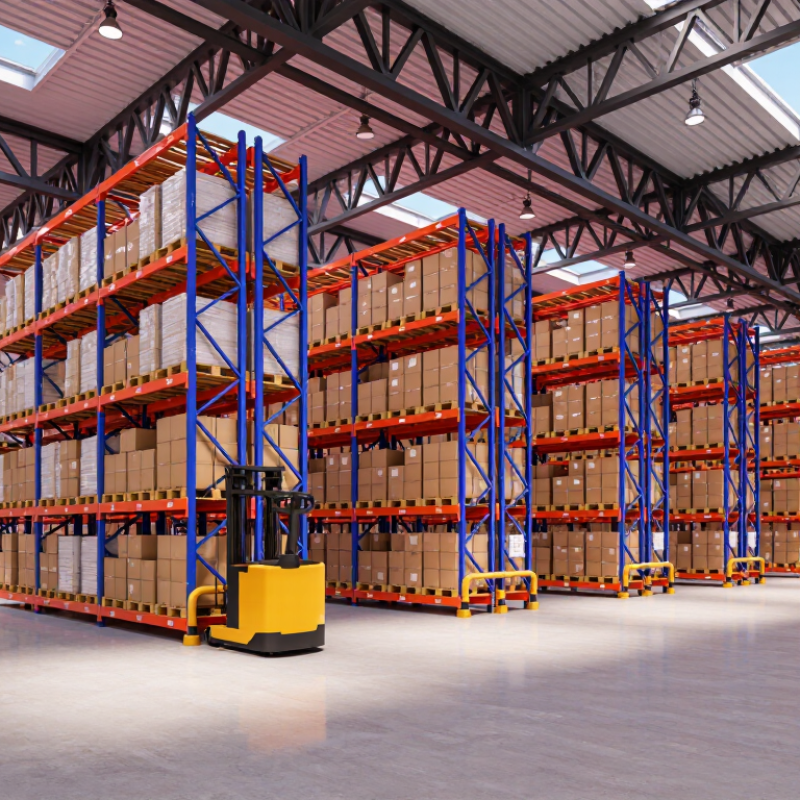
An adjustable pallet rack is a steel storage system with upright frames and movable horizontal beams. Operators change beam height to fit different pallet sizes. This simple feature separates it from fixed shelving. A forklift loads pallets directly into each storage position, while aisles provide access for daily picking.
In warehouse projects, I check pallet dimensions, load weight, forklift clearance, and floor conditions before selecting rack levels. A 1,000-kilogram pallet needs more than a strong-looking beam. It also needs correct beam deflection, secure connectors, and protected uprights. The MHI 2024 Annual Industry Report found that 43% of surveyed companies used robotics and automation. Adjustable racks can support these workflows, but rack geometry must match the equipment. Poor alignment creates expensive bottlenecks.
Safety depends on inspection, not appearance. EN 15635 recommends regular rack inspections, while ANSI MH16.1 provides design guidance for industrial steel storage racks. The exact design still requires competent engineering review. That part is often underestimated. In real facilities, uneven floors, damaged frames, and changing pallet loads can weaken a good design. I have seen storage plans fail because they measured the rack, but not the operation. A careful manufacturer should provide load charts, installation guidance, and traceable material information. Worker training and routine inspections remain essential after installation.
Choosing the best adjustable pallet rack manufacturer begins with the rack system’s practical features. Adjustable beams let operators change storage levels as pallet sizes evolve. This flexibility supports mixed inventory and reduces wasted vertical space. Beam connectors should lock firmly into upright frames. Safety pins add protection against accidental beam release.
Load capacity must be clearly documented for each beam level. It should reflect pallet weight, spacing, and the planned configuration. Upright frames need suitable thickness and stable base plates. In busy warehouses, durable powder coating helps resist scratches, moisture, and daily impact. Clear labels also help workers verify capacity during routine checks.
Good manufacturers provide layout drawings, installation guidance, and inspection instructions. These documents show professional control, not just sales language. Experienced planners also check aisle width, forklift turning space, floor strength, and ceiling clearance. Small details matter. I have seen attractive systems fail when floor conditions were ignored. That mistake is easy to repeat. Adjustable racks should be reviewed by qualified personnel and compared with applicable local safety requirements. A careful supplier will explain limits honestly, including what the system cannot support. Regular inspections should check bent uprights, loose connectors, missing pins, and uneven loading. Some designs appear simple, yet their safety depends on disciplined installation and use.
How to Evaluate Chinese Pallet Rack Manufacturers
Choosing the best adjustable pallet rack manufacturer requires evidence, not polished photographs. MHI’s 2023 Annual Industry Report found that 74% of supply chain professionals planned to adopt robotics and automation within five years. That trend increases demand for accurate rack layouts and reliable load data. Ask each manufacturer for stamped engineering drawings, beam deflection limits, upright testing, and steel certificates. A serious supplier should explain how seismic conditions, forklift impact, and uneven floors affect the design.
Visit the factory when possible. Watch the forming line, welding controls, coating process, and final inspection. Small details matter. Check whether every bundle carries a traceable production number. Request an independent test report, not only an internal quality statement. Compare the proposed steel grade, profile thickness, connector design, and surface coating. The cheapest quotation may hide thinner material or fewer safety accessories.
The European standard EN 15635 emphasizes inspection, maintenance, and safe rack use after installation. Therefore, evaluate the manufacturer’s manuals and training, not just its price. MHI data also shows that supply chain companies are increasing technology investment, making warehouse adaptability more important. Ask whether beams can be repositioned without damaging frames. Request references from facilities with similar loads. I would not pretend one factory is perfect. Even a qualified supplier can make mistakes when drawings, pallets, and site measurements do not match. A pre-production review can expose that weakness early.
China Best Adjustable Pallet Rack Manufacturer?
Manufacturing Standards and Quality Control
A reliable adjustable pallet rack begins with verified steel, not attractive photographs. Experienced manufacturers check thickness, yield strength, and chemical composition before production. Each steel batch should carry a traceable certificate. Inspectors also compare incoming materials against approved drawings.
Production control continues at every station. Automated punching must maintain consistent hole spacing across upright frames. Welds need visual inspection, while critical joints may require non-destructive testing. Finished beams should match specified dimensions within documented tolerances. Powder coating is checked for coverage, adhesion, and resistance to handling damage.
Load capacity must come from engineering calculations and controlled testing. Qualified engineers review beam deflection, frame stability, anchor requirements, and floor conditions. Testing should reflect real warehouse use, including uneven loading and repeated adjustments. That detail matters.
Independent audits can reveal weaknesses internal teams overlook. A practical audit may sample packed components, inspect labels, and review corrective-action records. Quality control is never perfect. A rushed measurement or poorly stored component can still create trouble. Manufacturers should record these failures, investigate their causes, and improve the process instead of hiding them. Buyers can request inspection reports, material certificates, dimensional records, and installation guidance before approving an order.
| Manufacturing Stage | Quality-Control Dimension | Applicable Standard or Reference | Recommended Control Data | Inspection or Verification Method | Required Evidence |
|---|---|---|---|---|---|
| Design Engineering | Rack load calculation | EN 15512; ANSI/RMI MH16.1 where applicable | Beam, upright, connector, bracing, base-plate and anchor calculations must reflect the stated bay load, pallet load, beam levels, seismic conditions and operating environment. | Independent engineering review of drawings, load tables and structural calculations. | Signed calculation package, approved drawings and clearly stated safe working loads. |
| Material Purchasing | Steel grade and traceability | EN 10204; EN 10025-2 or the specified national material standard | The steel grade, thickness, yield strength, tensile strength and elongation must match the approved design specification. A common structural grade such as S355JR has a minimum yield strength of 355 MPa for product thickness up to 16 mm, subject to the applicable standard and product form. | Review mill certificates and match heat numbers to incoming material labels. | Material test certificates, heat-number records and incoming inspection reports. |
| Incoming Inspection | Sheet, coil and component dimensions | Approved production drawings and relevant dimensional tolerances | Verify thickness, width, length, hole pitch, slot geometry, profile shape and straightness against the drawing. Tolerances must be defined before production rather than assumed after production. | Calibrated micrometers, vernier calipers, gauges, templates and measuring fixtures. | Incoming inspection checklist and calibrated equipment records. |
| Roll Forming and Punching | Upright profile and perforation accuracy | Approved production drawings; EN 15620 for installation-related tolerances | Check upright dimensions, hole spacing, hole orientation, profile twist, cut length and burr condition. Beam-level adjustability must match the specified pitch and connector design. | First-piece inspection followed by periodic in-process sampling using gauges and dimensional fixtures. | First-article approval, hourly or batch inspection records and nonconformance reports. |
| Welding | Weld quality and process control | ISO 3834; ISO 5817 for weld imperfection quality levels where specified | Welding procedures, consumables, prequalified parameters and welder competence must be controlled. Welds should be free from cracks, lack of fusion, unacceptable undercut, excessive porosity and visible incomplete penetration. | Visual inspection for all relevant welds; magnetic-particle, penetrant or other testing when required by the design or quality plan. | Welding procedure specifications, welder qualifications, inspection reports and corrective-action records. |
| Surface Preparation | Cleaning and pretreatment | Coating supplier specification and approved coating process | Oil, scale, rust, moisture and contaminants must be removed before painting or powder coating. Pretreatment chemistry, bath concentration, temperature and dwell time should be monitored. | Process-parameter checks, surface cleanliness inspection and contamination testing where required. | Pretreatment logs, chemical analysis records and process-control charts. |
| Coating or Galvanizing | Corrosion protection and finish consistency | ISO 1461 for hot-dip galvanized fabricated steel; coating specification for powder or liquid paint | Specify the coating system, target thickness, appearance requirements, adhesion requirements and corrosion environment. Hot-dip galvanized coating thickness depends on steel thickness and the applicable ISO 1461 requirements. | Dry-film thickness measurement, visual inspection, adhesion testing where specified and galvanized coating inspection. | Coating inspection report, thickness readings, batch records and approved color or finish sample. |
| Component Assembly | Beam-to-upright connection | EN 15512; approved connection design | Verify connector engagement, locking-pin installation, beam seating, connector deformation and compatibility between beam and upright profiles. Safety pins must be present where specified. | Functional assembly test and visual inspection using production samples. | Assembly test records, connection inspection checklist and approved sample unit. |
| Load Testing | Beam and frame performance | EN 15512 or ANSI/RMI MH16.1 design and verification requirements | Testing must use the actual section sizes, connection details and support conditions. The test plan should define load level, loading arrangement, measured deflection and permanent deformation limits. | Calibrated load cells, displacement gauges and documented test procedures. | Test report, calibration certificates, photographs and engineering review of results. |
| Final Inspection | Dimensions, appearance and completeness | Approved drawings, purchase specification and ISO 9001 quality-management procedures | Confirm component quantity, dimensions, coating condition, labels, holes, welds, accessories, packaging and identification against the purchase order. | Final sampling plan, visual inspection, dimensional inspection and packing-list reconciliation. | Final inspection report, release note, packing list and traceability records. |
| Installation and Handover | Stability, anchoring and operating safety | EN 15635; EN 15620; local building and seismic requirements where applicable | Check upright plumb, aisle clearance, beam levels, floor condition, anchor installation, protection devices, load plaques and visible damage. Operating and inspection instructions must be provided. | Site measurement, anchor verification, installation inspection and customer acceptance inspection. | Installation checklist, as-built drawings, load notices, maintenance instructions and handover documents. |
| Continuous Improvement | Nonconformity and corrective action | ISO 9001 quality-management principles | Defects should be classified by root cause, containment action, corrective action, responsible person and verification date. Repeated defects should trigger process review. | Corrective-action review, trend analysis and internal audits. | Nonconformance reports, corrective-action plans, audit reports and effectiveness verification. |
Choosing the best adjustable pallet rack supplier requires more than comparing prices. Start with your warehouse drawings, pallet dimensions, load weights, aisle widths, and future storage plans. A capable manufacturer should review these details before recommending beam sizes or frame heights. Ask for engineering calculations, material specifications, and clear load limits. Vague answers are warning signs.
Factory experience matters. Visit the production site when possible, or request current photos and inspection records. Check whether the supplier controls cutting, welding, coating, and final assembly. Steel thickness should match the stated capacity, not just the sales description. Ask how weld quality is checked and whether finished parts receive coating tests. Reliable suppliers can explain their process without avoiding difficult questions.
Communication is equally important. Confirm drawing approval, sample inspection, packaging, delivery schedules, and replacement procedures in writing. Request references from warehouses with similar pallet weights and operating conditions. A lower quotation may omit anchors, guards, installation support, or testing. That difference can become expensive later. No supplier is perfect. I would still question any company promising zero delays or unlimited customization. Specifications can change after a site measurement, and honest suppliers should explain the impact. Choose the manufacturer that documents risks, responds clearly, and supports safe installation after delivery.
It is a steel storage system with upright frames and movable horizontal beams. Operators change beam height for different pallet sizes. Forklifts load pallets directly into each storage position.
Adjustable racks allow beam positions to change. Fixed shelving usually keeps storage levels in one position. This flexibility supports mixed pallet heights.
Check pallet dimensions, load weight, forklift clearance, and floor conditions. A 1,000-kilogram pallet needs proper beam strength and connector security. Measure the operation, not just the rack.
They can support automation when rack geometry matches the equipment. Incorrect spacing may create bottlenecks near aisles and loading points. Compatibility needs engineering review.
Safe design considers beam deflection, frame stability, anchors, and floor conditions. Uprights also need protection from forklift impacts. Strong-looking steel is not enough.
Inspect racks regularly and after visible impacts or major load changes. Look for bent frames, loose connections, damaged beams, and uneven loading. Appearance can be misleading.
The manufacturer should verify steel thickness, strength, and chemical composition. Hole spacing, welds, beam dimensions, and coating adhesion also need inspection. Small measurement errors can matter.
Request load charts, material certificates, inspection reports, dimensional records, and installation guidance. Corrective-action records may reveal recurring problems. No process is perfect.
Uneven floors can affect frame stability and anchor performance. A rack may be correctly assembled but still perform poorly on a weak surface. This is easy to underestimate.
An Adjustable Pallet Rack is a flexible warehouse storage system designed to hold palletized goods at different heights and positions. Its main benefits include adjustable beam levels, strong load-bearing capacity, efficient use of vertical space, easy access to stored products, and compatibility with forklifts and common warehouse operations. A well-designed system can improve inventory organization, storage density, and workplace efficiency while adapting to changing business needs.
When evaluating Chinese pallet rack manufacturers, buyers should examine production experience, engineering capabilities, material quality, welding precision, surface treatment, load testing, and consistency in quality control. Reliable suppliers should follow recognized manufacturing standards, provide clear technical specifications, conduct inspections throughout production, and offer professional support. The best supplier should be selected according to load requirements, warehouse layout, budget, delivery expectations, installation services, customization needs, and long-term after-sales support. A careful comparison of these factors helps ensure a safe, durable, and cost-effective storage solution.