Double Deep Pallet Racking can increase storage density by placing two pallets behind each other. It may reduce the number of operating aisles and make better use of floor space. The trade-off is access: reaching the rear pallet usually requires suitable reach equipment and careful inventory planning. That detail matters.
This guide introduces ten manufacturers and compares the factors buyers should examine before requesting a quote. These include rack design, stated load capacities, materials, customization options, installation support, warranty terms, and the availability of replacement components. A polished product page is not enough. Ask for clear engineering documentation and confirm that proposed specifications match your pallet sizes, forklift operations, and warehouse conditions.
No single manufacturer is best for every facility. Regional service, project scale, lead times, and budget can all change the decision. It is also easy to focus on storage capacity while overlooking daily picking speed; that is a mistake worth revisiting. Use the list as a starting point, then compare written proposals and ask vendors how their systems handle real operating needs. Before making a commitment, have qualified professionals review the layout and load requirements. A ranking can guide research, but it cannot replace a site-specific assessment.
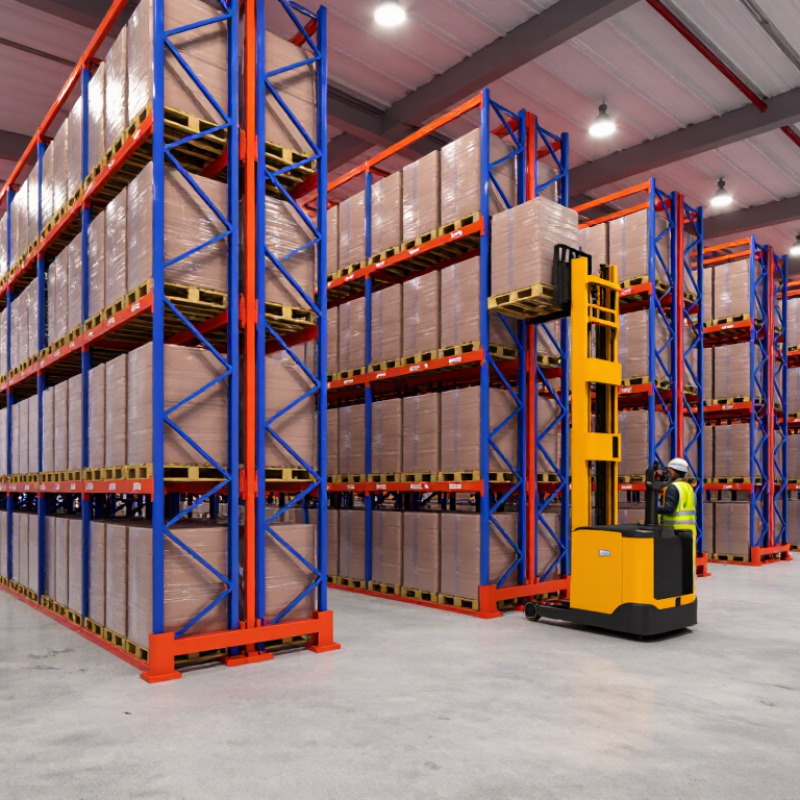
Double deep pallet racking stores two pallets behind each other in one rack bay. Instead of reaching every load from the aisle, a compatible deep-reach truck extends its forks to place or retrieve the rear pallet. The front pallet occupies the first position. Then the second sits directly behind it. Space gained.
Because the rear pallet is partly blocked, access follows a last-in, first-out pattern within each lane. Operators usually remove the front load before reaching the one behind it. This works best when each lane holds the same product, or when older stock does not need immediate access. Mixed inventory can make picking slower. That trade-off matters.
The rack layout, truck reach, pallet dimensions, and floor condition should be checked together. A few centimeters of clearance can affect stable placement, especially with uneven loads or damaged pallets. Warehouse teams should confirm load ratings and operating clearances with qualified rack and equipment professionals. Do not rely on aisle width alone. It is easy to overestimate the usable capacity; reduced selectivity and extra handling can offset the saved space. That balance deserves a real site trial, not just a drawing.
Illustrative pallet-position capacity for the same rack bay configuration.
The example assumes three pallet positions across and four beam levels. Single-deep racking stores one pallet deep (12 positions); double-deep racking stores two pallets deep (24 positions). The rear pallet sits behind the front pallet, so access typically requires a deep-reach forklift and is less direct.
Evaluating double deep pallet racking manufacturers starts with the loads and layout your warehouse actually needs. Share pallet dimensions, maximum weights, aisle widths, and forklift specifications. A qualified manufacturer should explain how these details shape rack design, capacity ratings, and installation requirements. Ask for clear engineering drawings and load information, not just a sales estimate. Check how components are inspected and how production quality is documented. Small details matter. A beam connection that looks sturdy still needs to suit the specified system.
Tips: Bring a real warehouse plan to supplier discussions. Ask how operators will access rear pallets and what equipment changes may be needed. Compare proposals using the same load and layout assumptions; otherwise, the prices may not describe equivalent systems.
Review the manufacturer’s installation guidance, warranty terms, spare-part availability, and after-sales support. Ask for references from facilities with similar storage needs, then confirm what those projects involved. A polished proposal is useful, but it cannot replace careful verification. Some criteria are easy to score; service quality is harder to judge before a problem occurs. That uncertainty deserves a direct question, not a guess.
Use these criteria to compare manufacturers. The table is an evaluation framework, not a ranked list of companies.
| No. | Evaluation Criterion | What to Check | Useful Evidence | Why It Matters for Double-Deep Racking |
|---|---|---|---|---|
| 1 | Structural design and engineering | Confirm that the design accounts for pallet loads, beam spans, rack height, layout, seismic conditions where applicable, and site-specific operating requirements. | Project-specific drawings, design calculations, load tables, and applicable engineering documentation. | Rack capacity depends on the complete configuration and installation conditions; generic capacity figures are not enough. |
| 2 | Applicable standards and code familiarity | Ask which current local codes and relevant standards will govern design, installation, inspection, and use. Examples include ANSI MH16.1 in the United States and EN 15512, EN 15620, EN 15629, and EN 15635 in European contexts. | A written statement of the design basis and the standards applicable to the project location. | Requirements vary by jurisdiction and project; the manufacturer should identify the relevant basis rather than imply that one standard applies everywhere. |
| 3 | Double-deep layout expertise | Check that the proposed layout specifies bay dimensions, flue spaces, clearances, pallet orientation, and access to both pallet positions in each lane. | Dimensioned layout drawings and a documented review of site and pallet measurements. | Double-deep storage places pallets two deep, so accurate clearances and access planning are essential for safe handling. |
| 4 | Forklift and handling-equipment compatibility | Verify the reach truck or other handling equipment can access the rear pallet position and operate within the proposed aisle and clearance dimensions. | Equipment specifications, aisle-width assessment, and an operational layout review. | Double-deep systems commonly require suitable deep-reach equipment; equipment compatibility affects both access and aisle planning. |
| 5 | Load data and pallet specification review | Provide the range of pallet sizes, maximum loaded weights, load distribution, and any non-standard or damaged pallet conditions for review. | A documented load schedule and written confirmation of the design assumptions. | Capacity must be checked against the actual pallet and load conditions; do not compare systems using an unqualified maximum-load claim. |
| 6 | Material quality and component traceability | Ask for material specifications, component identification methods, and quality-control procedures for uprights, beams, connectors, and accessories. | Product data sheets, inspection records, and component identification details. | Traceable components make it easier to verify replacement parts and keep the installed system consistent with its design. |
| 7 | Installation planning and quality control | Confirm who is responsible for installation, anchoring, alignment checks, handover, and resolving site deviations. | Installation method statement, installer qualifications, inspection checklist, and handover documents. | The installed rack must match the approved design and the site conditions for its specified performance to be meaningful. |
| 8 | Inspection, maintenance, and damage response | Check whether the supplier provides inspection guidance, damage reporting procedures, repair recommendations, and information on when affected areas should be unloaded. | Inspection guidance, maintenance documentation, and a clear service or repair process. | Rack condition can change in service; EN 15635, where applicable, addresses the use and maintenance of steel static storage systems. |
| 9 | Warranty and after-sales support | Review warranty scope, exclusions, response arrangements, spare-part availability, and support coverage for the project location. | Written warranty terms, service contact details, and spare-part policies. | Clear support terms help facilities plan maintenance and manage repairs over the system's operating life. |
| 10 | Total project cost and delivery reliability | Compare the full quoted scope, including design, components, freight, installation, accessories, and stated delivery assumptions. | Itemized quotation, delivery schedule, scope exclusions, and project milestone plan. | A like-for-like comparison reduces the risk of overlooking installation, handling, or other costs that are not included in a headline price. |
Final selection should be based on a project-specific design review, applicable local requirements, documented load assumptions, and the total installed scope.
A credible top-ten comparison of double deep pallet racking manufacturers should focus on engineering and site fit, not catalogue claims. Double deep systems store pallets two positions deep, improving storage density while reducing direct access to each load. That trade-off matters. Buyers should check beam capacity, upright specifications, connection details, installation tolerances, and compatibility with the intended reach truck. Ask for calculations based on actual pallet weights, rack height, floor conditions, and local seismic requirements.
MHI’s 2024 Annual Industry Report found that 55% of surveyed supply-chain professionals planned to increase technology investment. This supports assessing whether a manufacturer can provide clear layout data and coordinate its racks with warehouse equipment and controls. Request comparable drawings, load tables, inspection guidance, spare-part availability, and references for similar installations. Small details count. A low quoted price may omit protection, installation, or future changes. A ranking can mislead, too: the best supplier for a high-throughput distribution centre may not suit a smaller facility with varied pallet sizes. Verify every claim against your own operating needs.
When comparing the top 10 double-deep pallet racking manufacturers, look beyond storage density. Their systems should fit your pallet dimensions, load weights, aisle widths, and forklift reach.
Ask for clear layout drawings and capacity data for each beam level. A small change in pallet overhang can affect clearance and access. Double-deep storage also limits direct access to rear pallets, so inventory rotation needs thought.
Safety details matter. Check how manufacturers specify beam connectors, upright protection, floor anchoring, and inspection requirements. Their guidance should explain what to do after an impact, not just how to install the rack. No chart catches every site condition. Still, it helps. Compare installation training, replacement-part availability, and how quickly technical questions receive useful answers. Ask whether support includes reviewing a revised layout when operations change. A polished brochure is not proof of dependable service. I would also check whether quoted load ratings match the actual configuration, including rack height and pallet position. Some comparisons miss this detail. That is worth a second look.
Choosing a double deep pallet racking manufacturer starts with your actual warehouse conditions, not a glossy catalogue. Share pallet dimensions, maximum load weights, aisle widths, ceiling height, and a floor plan. Ask how the proposed layout affects forklift reach and access to rear pallets. A system that saves aisle space may slow picking if equipment or workflows are poorly matched. Measure twice.
Look for clear load calculations, installation drawings, material specifications, and documented quality checks. Ask who verifies the design and what information they need about your floor slab and operating environment. Request references for projects with similar pallet loads and handling equipment. Details matter. Compare warranties, replacement-part availability, and response times—not just the initial quote. A manufacturer should explain inspection and maintenance needs in plain language, without promising that racks are maintenance-free.
If possible, review a sample connection or visit an installed system before committing. Check that beams lock securely and labels remain readable from the aisles. Ask how future changes affect capacity; moving a beam can alter the rated load. No checklist catches everything, and a site survey may still reveal surprises. Choose a supplier willing to discuss trade-offs and revise the design when field measurements differ.
It holds two pallets behind each other in one rack bay. A compatible deep-reach truck places or retrieves the rear pallet. More storage, but access changes.
Usually, they must remove the front pallet first. Each lane therefore follows a last-in, first-out pattern. Not ideal for every product.
Lanes work best when they hold the same product. Mixed inventory can slow picking, especially when workers need a specific rear pallet.
Check pallet dimensions, load weights, aisle widths, truck reach, and floor condition together. Even a few centimeters can affect placement.
Review beam connectors, upright protection, floor anchoring, and inspection requirements. Ask what to do after an impact. A chart cannot cover every site condition.
Not necessarily. Extra handling and reduced selectivity can offset the saved space. I might trust a layout drawing too quickly.
Ratings should match the rack height and pallet position. Ask for capacity data for each beam level, not just a general figure.
Look for installation training, available replacement parts, and useful answers to technical questions. Ask whether support includes reviewing changed layouts. A polished brochure proves little.
No. A site trial can reveal clearance problems that a drawing misses. Check actual loads, pallet condition, and truck movement. Fresh paint hides little.
This article explains how Double Deep Pallet Racking stores pallets two positions deep, increasing storage density while requiring suitable access equipment and careful planning. It outlines the main criteria for evaluating manufacturers, including system design, load capacity, material quality, customization options, installation expertise, safety features, and after-sales support. These factors help warehouse operators compare potential suppliers beyond price alone.
The guide also describes how to assess racking products, safety provisions, and ongoing service, then offers practical considerations for selecting a manufacturer. Readers are encouraged to match a system to their warehouse layout, inventory profile, handling equipment, and future growth plans. By weighing space efficiency against accessibility, operational needs, and support, businesses can make a more informed decision about the right Double Deep Pallet Racking solution for their facility.