A warehouse can lose valuable space in the gaps between pallet rows. Deep Lane Pallet Racking offers a way to store more goods within a compact footprint. Instead of giving every pallet its own aisle, the system places pallets several positions deep. This arrangement can suit operations that hold many pallets of the same product. It may also reduce the number of aisles forklifts need to travel.
The trade-off is access. In many configurations, workers retrieve the last pallet loaded only after moving the pallets in front of it. That affects picking speed and stock rotation. A system that looks efficient on a floor plan may feel less convenient during a busy shift. Worth considering.
Choosing the right setup depends on pallet dimensions, load weights, product variety, and how often stock moves. Forklift type and operator training matter too. A warehouse with steady, high-volume storage needs may benefit more than one handling many different items each day. Measure the space carefully. Check clearances, rack capacity, and traffic patterns with a qualified storage-system professional before making a decision. Their assessment should reflect actual operating conditions, not just the maximum number of pallet positions. Deep Lane Pallet Racking can improve storage density, but it is not a universal fix. The best result comes from balancing capacity with safe, practical access.
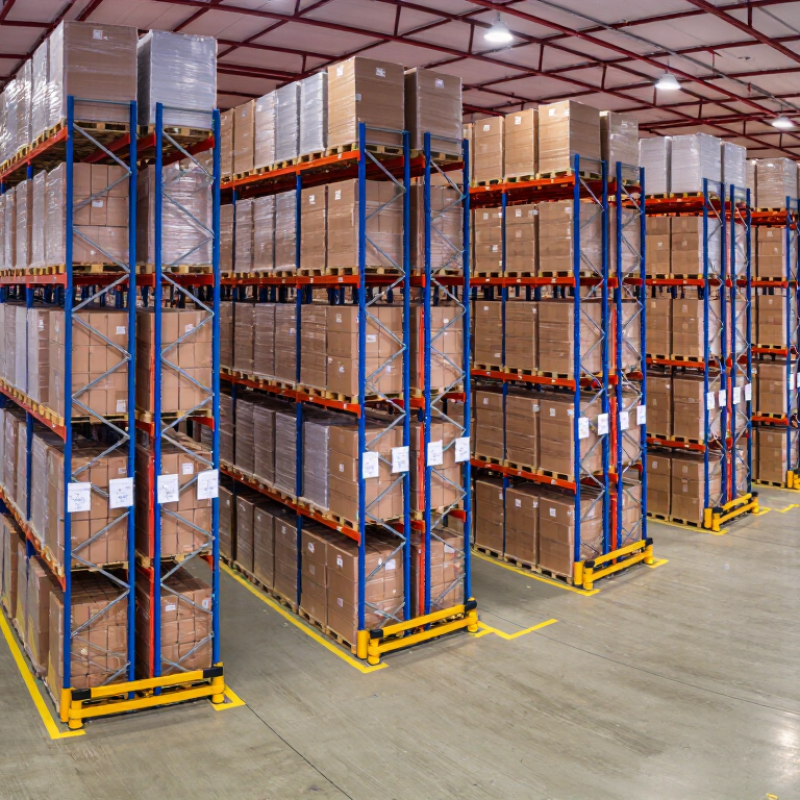
What Defines Deep-Lane Pallet Racking, Typically 2–10 Pallets Deep?
Deep-lane pallet racking stores pallets several positions deep within each lane, rather than placing every pallet at the aisle edge. In common layouts, a lane holds roughly two to ten pallets in a single line. The exact depth depends on pallet size, load stability, handling equipment, and how often stock moves. Picture a forklift carrying a pallet into a narrow channel and setting it behind the pallet already at the front. That is the defining arrangement. Less aisle space is needed per stored pallet, but access to individual loads becomes less direct. Small detail, big effect.
Many systems are designed for one product or SKU per lane, since front pallets can block those behind them. This suits batches of similar goods, such as boxed cartons on standard pallets, especially when several units arrive together. With drive-in access, pallets are commonly loaded and retrieved from the same end, often following last-in, first-out stock rotation. Drive-through designs can provide access at both ends and may support first-in, first-out handling when the workflow is planned accordingly. Yet it is easy to overestimate the benefit. A lane that is too deep can leave slow-moving stock buried and complicate replenishment. Measure actual pallet dimensions, forklift clearance, and inventory turnover before choosing a depth. The drawing may look tidy; a working warehouse rarely behaves perfectly.
Why Choose Deep-Lane Pallet Racking for Your Warehouse? — What Defines Deep-Lane Pallet Racking, Typically 2–10 Pallets Deep?
| Dimension | Typical Deep-Lane Characteristics | Warehouse Implication |
|---|---|---|
| Definition | A high-density storage arrangement in which pallets are stored several positions deep in a lane, commonly around 2–10 pallets deep depending on the system design. | Uses storage depth to increase pallet positions within a given floor area compared with many selective-rack layouts. |
| Access method | In drive-in systems, a forklift enters the storage lane to place or retrieve pallets. Drive-through systems allow access from both ends. | Lane access and forklift movement need to be planned around aisle width, lift-truck dimensions, and operating procedures. |
| Stock rotation | Drive-in lanes commonly operate on a last-in, first-out (LIFO) basis. Drive-through lanes can support first-in, first-out (FIFO) when loading and retrieval are managed from opposite ends. | Choose the operating pattern to match product rotation requirements, shelf life, and inventory controls. |
| Storage density | Multiple pallet positions are grouped behind a lane opening, reducing the number of separate access aisles needed for storage. | Can be useful when floor space is constrained and many pallets share the same product or SKU. |
| SKU suitability | Works best when a lane holds a substantial quantity of the same SKU or compatible product, with relatively few product changes within the lane. | Many low-volume SKUs may be harder to access efficiently because pallets behind the front positions can be blocked by other pallets. |
| Selectivity | Individual pallet access is generally lower than in selective pallet racking, especially in deeper lanes. | Consider whether the space savings justify reduced access to pallets stored farther inside a lane. |
| Loading and retrieval | Pallets are typically handled in lane sequence. The required sequence varies with the rack configuration and inventory method. | Clear put-away and retrieval rules help limit unnecessary pallet movements and reduce the risk of disturbing adjacent loads. |
| Forklift and operator requirements | Drive-in layouts require the lift truck to travel into a lane and operate near rack structure. The truck and load must be suitable for the lane dimensions. | Check equipment compatibility, visibility, operator training, and safe clearances before selecting a layout. |
| Pallet consistency | Consistent pallet dimensions, condition, and load stability make deep-lane storage easier to manage. | Damaged, irregular, or unstable pallets can create handling difficulties and should be managed according to site procedures. |
| Rack design and capacity | Beam, rail, upright, bracing, anchorage, and load limits must be designed for the actual pallet loads and operating conditions. | Storage capacity is system-specific; use a qualified rack designer or engineer to verify the layout and rated loads. |
| Common applications | Often considered for cold storage, seasonal inventory, and bulk storage where products are handled in larger quantities. | Suitability depends on product turnover, SKU profile, required rotation, equipment, and the value of floor-space savings. |
| Key planning trade-off | Greater storage density is balanced against lower selectivity and the need for disciplined lane management. | Compare pallet-position gains with access requirements, handling time, safety needs, and inventory practices before installation. |
Planning note: “2–10 pallets deep” is a general description, not a universal design standard. Actual lane depth, pallet capacity, clearances, and load ratings depend on the rack design, pallet and load dimensions, lift-truck equipment, and applicable safety requirements.
FAQS
It stores several pallets behind one access point. Fewer aisles may be needed, leaving room for more pallet lanes. A four-deep lane holds four pallets at each level, but reaching the rear pallets takes planning.
LIFO lanes load and retrieve pallets from the same end. The newest pallet is usually removed first. This can suit uniform goods with flexible rotation dates, though older stock may remain behind newer pallets.
Pallets enter at the rear and move forward on gravity rollers. The oldest pallet becomes available at the picking face first. Labels and routine checks help, but careful loading still matters.
Match the lane to product rotation needs, pallet condition, and forklift access. Date-sensitive stock may need FIFO handling. A dense layout alone is not enough reason to choose a lane type.
Products with matching SKUs and predictable rotation are often easier to group in one lane. Check that pallet sizes and conditions are compatible. Mixed stock can make access awkward.
Not necessarily. Front pallets can block those behind them, and forklifts may need extra movements. Test typical loading and retrieval tasks before setting lane depth. Access still matters.
Record the heaviest planned pallet, beam elevations, rack height, and bay width. Check forklift clearance and planned changes too. A beam rating alone does not confirm the full rack’s capacity.
Engineers should use the adopted seismic criteria and verify rack stability, connections, anchorage, and force transfer to the floor. Confirm slab thickness and anchor locations against drawings and field conditions. Small details matter.
Replenishment routines and rear-pallet access can take more time than expected. Review lane contents regularly and compare usable positions with handling time. It is worth checking again.
Conclusion
Deep Lane Pallet Racking stores pallets several positions deep—typically two to ten—in each lane, reducing the number of aisles and increasing storage density. Its layout can support LIFO, where the last pallet loaded is the first retrieved, or FIFO, where pallets move through the lane to preserve first-in, first-out rotation. The right design depends on inventory flow, SKU variety, turnover, and the need to access individual pallets.
By concentrating storage in fewer aisles, multi-deep systems can create more pallet positions within a given warehouse footprint. Planning should account for pallet and rack loads, operating conditions, and seismic requirements, with design checks informed by ANSI MH16.1 and ASCE 7. Forklift type and maneuvering capabilities also affect lane depth and system suitability. Deep Lane Pallet Racking is most effective when its high-density layout matches the warehouse’s handling equipment and stock-rotation needs.