[email protected] Exporting to 60+ Countries
0%

Global warehouses face uneven demand, varied product sizes, and constant pressure on floor space. Heavy Duty Pallet Racking offers a practical response. It uses vertical capacity while keeping pallets visible, accessible, and organized. In a busy distribution center, that difference matters.

John J. Bartholdi III, a respected warehouse-design educator, expresses the principle clearly: “Storage is not simply about putting products away; it is about making every movement purposeful.” His view reflects an important reality. A rack system is not merely steel and beams. It shapes travel paths, replenishment work, picking speed, and inventory accuracy. Well-planned Heavy Duty Pallet Racking can support forklifts, standard pallet footprints, and changing stock profiles across international operations.

But the decision is not automatically correct. It depends on pallet weight, beam spans, aisle widths, handling equipment, and local safety requirements. A rack that performs well in one warehouse may create congestion in another. That assumption can fail. Site measurements, load calculations, seismic considerations, fire protection, and professional installation deserve careful review. Small errors become expensive quickly.

A reliable global strategy therefore combines robust rack components with disciplined inspections and clear operating procedures. Damaged frames should never be ignored. Labels should remain readable. Operators need practical training, not only written instructions. Heavy Duty Pallet Racking can improve capacity and workflow, but it cannot repair weak planning. The strongest results come from matching the system to real products, real movement, and real people. It is powerful, not magical.
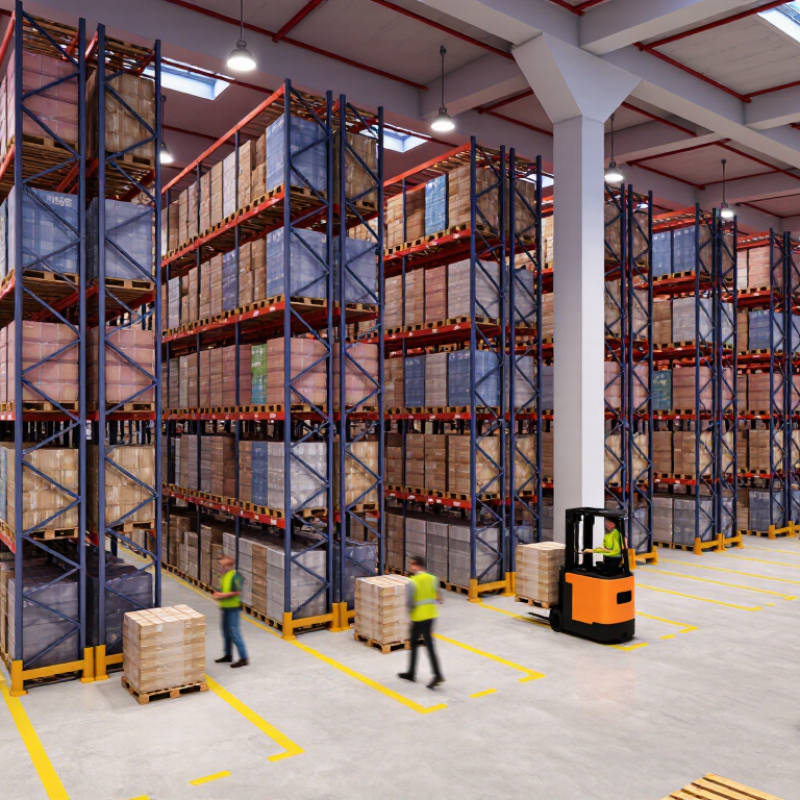
Why Choose Heavy Duty Pallet Racking for Global Warehouses?

What Is Heavy-Duty Pallet Racking?

Heavy-duty pallet racking is an engineered steel storage system for palletized loads. It normally includes upright frames, horizontal beams, anchors, decking, and load plaques. Unlike light shelving, it carries concentrated loads at several vertical levels. Design depends on pallet weight, bay width, beam span, forklift clearance, floor strength, and seismic conditions.

ANSI MH16.1 provides North American design requirements for industrial steel storage racks. OSHA 1910.176(b) also requires stored materials to remain secure and not create hazards.

These rules matter during daily operations. A rack may look strong, yet poor anchoring or an overloaded beam can create a serious failure point. Capacity labels alone do not make a system safe.

MHI’s 2024 Annual Industry Report surveyed more than 2,000 supply-chain professionals and found that 83% expected greater technology adoption within five years. That shift supports digital inventory checks and scheduled rack inspections. In practical warehouse audits, the useful details are often simple: visible beam locks, undamaged uprights, clear aisle markings, and pallets sitting fully on both beams. Forklifts are not perfectly gentle. Impact protection should be treated as part of the design, not an optional decoration. One imperfect assumption remains common: selecting the highest capacity available. A better decision matches real loads, future growth, and local engineering requirements.

How Heavy-Duty Pallet Racking Supports Global Warehouse Operations

Why Choose Heavy Duty Pallet Racking for Global Warehouses?

Heavy-duty pallet racking gives global warehouses a stable storage foundation. It supports dense pallet placement, clearer aisles, and safer movement during peak seasons. The 2024 MHI Annual Industry Report found that 83% of supply chain professionals expect technology and innovation investment to increase. Racking must support that change, not obstruct it. Adjustable beam levels can accommodate different pallet heights, packaging formats, and regional inventory requirements.

Consistency matters across countries. A warehouse in Rotterdam may handle different loads from one in Singapore. Standardized rack layouts help teams train faster and inspect equipment more consistently. The 2024 WERC DC Measures report identifies order-picking accuracy as a critical performance benchmark, with leading operations approaching 99.5% accuracy. Well-positioned pallets reduce searching, double handling, and avoidable picking errors. Small improvements matter.

Design still requires judgment. More storage density is not automatically better. Narrow aisles may increase capacity, but they can slow replenishment and complicate emergency access. Engineers should review floor loading, seismic conditions, forklift turning paths, sprinkler clearance, and local safety requirements. Real operating experience often exposes weaknesses that drawings miss. A damaged upright can look minor. It is not. Regular inspections, documented load ratings, and prompt repairs help maintain dependable performance across complex warehouse networks.

Key Benefits for Storage Capacity, Efficiency, and Inventory Control

Heavy-duty pallet racking gives global warehouses a practical way to expand storage without expanding their buildings. Adjustable beam levels use vertical space above forklifts and staging areas. A properly engineered bay can hold several pallets, but capacity depends on load weight, pallet dimensions, beam span, and seismic conditions. Guessing here is expensive.

The 2024 MHI Annual Industry Report found that 55% of supply-chain leaders planned to increase technology and innovation investment. Racking works better when connected to that investment. Barcode locations, handheld scanners, and warehouse management software can record every pallet movement. Clear location labels reduce search time and support cycle counting. Small details matter. A misplaced pallet can distort inventory figures before the next shift begins.

Efficiency also depends on safe, repeatable movement. Defined aisles, protected uprights, and visible load plaques help operators work consistently. The 2023 Warehousing Vision Study reported that 58% of warehouse decision-makers planned to deploy RFID by 2028. RFID can improve tracking across receiving, storage, and dispatch, especially across multiple countries. Yet technology cannot repair a poor layout. Narrow aisles may increase capacity while slowing picking. I have seen storage plans look excellent on paper, then fail during peak-hour traffic. Regular rack inspections, seasonal demand reviews, and honest capacity checks keep inventory control grounded.

Why Choose Heavy Duty Pallet Racking for Global Warehouses? - Key Benefits for Storage Capacity, Efficiency, and Inventory Control

Benefit Area Measurable Dimension Typical Data or Standard Range Operational Significance Inventory and Warehouse Impact
Storage Capacity Common pallet footprint 1,200 × 800 mm for a Euro pallet; 48 × 40 in for a GMA pallet Rack bays and beam lengths can be configured around regionally used pallet sizes. Standardized dimensions improve space planning and reduce unusable gaps between loads.
Storage Capacity Vertical utilization Usually 3–5 pallet levels in facilities with suitable clear height Using vertical space increases pallet positions without expanding the building footprint. More stock-keeping capacity can be created within the same floor area, subject to fire, seismic, and building restrictions.
Storage Capacity Illustrative bay capacity 4 pallet positions per level × 4 levels = 16 pallet positions per bay A modular bay arrangement makes capacity easy to calculate and expand. Warehouse planners can forecast pallet positions by aisle, zone, product family, and future growth.
Load Safety Beam and upright capacity Specified by structural design; the rated load must be displayed and never exceeded Heavy-duty systems are engineered for the combined weight of pallets, beams, frames, and operational forces. Clear load ratings support safer put-away, reduce overloading risk, and improve compliance inspections.
Space Efficiency Selective rack aisle width Commonly about 3.0–3.7 m for conventional counterbalance forklift operation Aisle width must match the truck type, turning radius, pallet dimensions, and handling method. Correct aisle planning balances accessibility with the number of available pallet locations.
Space Efficiency Narrow-aisle configuration Often approximately 1.8–2.5 m, depending on equipment and rack layout Narrow aisles can increase storage density when compatible reach or turret trucks are used. More positions may fit in the same building, although equipment and training requirements are higher.
Accessibility Direct pallet access One accessible pallet position per facing in selective racking Each pallet can normally be reached without moving another pallet first. Supports high-SKU operations, faster picking, and easier cycle counting.
Inventory Control Stock rotation method FIFO is practical with direct-access layouts; LIFO is common in deep-lane storage The rack design should match product expiry dates, batch rules, and dispatch priorities. Correct alignment between rack type and rotation policy helps reduce aging, obsolescence, and expired stock.
Inventory Control SKU location accuracy Location coding can identify aisle, bay, level, and position Structured addresses create a consistent map for warehouse management systems and manual controls. Better location visibility improves receiving, replenishment, picking, and stock reconciliation.
Handling Efficiency Load unit standardization One pallet position should use a compatible pallet type, load height, and overhang limit Consistent unit loads reduce rehandling and simplify forklift positioning. More predictable handling improves throughput and reduces damage caused by unstable or incompatible loads.
Scalability Configuration flexibility Beam levels can be repositioned to accommodate different load heights Adjustable levels allow the layout to respond to changing product dimensions and demand patterns. Storage capacity can be rebalanced without replacing the complete rack structure.
Global Deployment International design considerations Pallet standards, seismic requirements, fire codes, aisle rules, and local regulations vary by market A global warehouse program requires site-specific engineering and regulatory review. Local compliance checks reduce installation delays and support consistent safety practices across regions.
Asset Protection Rack protection requirements Frame guards, end-of-aisle barriers, load notices, and inspection procedures are commonly used Protection measures help limit damage from forklifts and other material-handling equipment. Fewer rack-impact incidents can reduce repair costs, downtime, and risks to personnel and inventory.
Performance Management Key warehouse indicators Pallet positions, occupancy rate, pick rate, stock accuracy, damage rate, and order cycle time These metrics connect rack design with measurable warehouse performance. Regular measurement helps identify congestion, underused locations, inaccurate records, and capacity constraints.

Note: Capacity, aisle width, rack height, and configuration must be validated by a qualified storage-system designer for the specific building, pallet load, forklift, seismic zone, fire-protection system, and applicable local regulations.

How to Select and Configure the Right Racking System

Why Choose Heavy Duty Pallet Racking for Global Warehouses?

Selecting a heavy duty pallet racking system starts with real operating data, not catalogue images. Record pallet dimensions, gross weight, SKU turnover, forklift type, and required storage height. The MHI 2024 Annual Industry Report found that 55% of supply-chain professionals planned to increase technology and innovation investment. That investment should support better storage decisions, not simply denser aisles.

Measure the building carefully. Check slab capacity, clear height, column positions, fire systems, seismic exposure, and forklift turning radius. Selective racking suits many SKUs and direct access. Drive-in systems provide higher density, but reduce access and may increase handling risks. Double-deep layouts need suitable equipment and disciplined inventory control. Leave practical clearance around beams and sprinklers. Small errors become expensive.

Load configuration deserves engineering review. Calculate upright frames, beam capacity, anchoring, impact protection, and deflection limits for every level. EN 15635 recommends regular inspections and documented action after damage. The Rack Manufacturers Institute also emphasizes designing around actual loads and operating conditions. Do not rely on average pallet weight. It hides the heaviest cases.

Global warehouses often require local verification. National building, fire, and seismic rules can differ sharply. A qualified engineer should review the final layout and calculations. Some teams still optimize only floor utilization. That is a mistake. Travel time, replenishment frequency, inspection access, and future SKU changes may matter more than one extra pallet position. Perfect density is rarely perfect operations.

Why Choose Heavy-Duty Pallet Racking for Global Warehouses?

Heavy-duty pallet racking supports high-density storage and allows configuration around pallet weight, pallet dimensions, beam levels, and handling equipment. The chart below shows the required beam-level working load for common configurations using a 1,000 kg working load per pallet.

Planning example: 2, 3, or 4 pallets at 1,000 kg each require 2,000, 3,000, or 4,000 kg of working load capacity per beam level. Final rack selection must verify pallet footprint, beam span, upright capacity, aisle width, seismic conditions, forklift type, and applicable local design standards.

Safety, Compliance, and Maintenance Across International Warehouses

Why Choose Heavy Duty Pallet Racking for Global Warehouses?

Safety begins with accurate design, not simply thicker steel. Heavy duty pallet racking supports dense inventory, but every beam must match its rated load. Warehouse engineers should assess pallet weight, forklift traffic, floor strength, and seismic conditions. Local building and fire requirements also matter. A system accepted in one country may need different anchoring or protection elsewhere.

Clear load plaques help operators make safer decisions. So does training. Workers should understand beam locking pins, damaged uprights, uneven pallets, and safe clearance heights. In busy facilities, small impacts happen. They should never be ignored. One bent frame can affect an entire bay. A documented inspection program should include daily visual checks, scheduled technical inspections, and immediate isolation of unsafe sections.

Maintenance differs across climates. Humid ports may require corrosion monitoring, while cold warehouses can expose brittle components and slippery floors. Inspect anchors, bracing, welds, connectors, and floor cracks. Replace damaged parts with approved equivalents, not improvised repairs.

Keep inspection records in a shared language or with clear translations for international teams. Digital records can improve traceability, though they are useless when staff do not update them.

A checklist is not enough. Real reliability depends on routine behavior. Some warehouses still inspect only after an incident, which is a costly weakness. Reviewing near misses, seasonal workload changes, and new forklift routes can reveal risks earlier. Continuous improvement may feel slow, but it protects people, inventory, and operational continuity.

FAQS

What is heavy-duty pallet racking?

It is an engineered steel system for storing palletized loads at multiple vertical levels. It usually includes upright frames, beams, anchors, decking, and load plaques. It supports concentrated loads. Not light shelving.

What factors determine rack capacity?

Capacity depends on pallet weight, bay width, beam span, forklift clearance, and floor strength. Seismic conditions may also change the design. The strongest available system is not always the right choice.

Why are clear load plaques important?

Load plaques show operators the permitted weight and storage arrangement. They reduce guesswork during busy shifts. A label alone cannot make an unsafe rack safe.

How can warehouses improve rack safety?

Keep pallets fully supported by both beams. Check beam locks, upright frames, anchors, and aisle markings. Remove unsafe sections immediately. Small impacts matter.

How often should pallet racking be inspected?

Workers should perform visual checks during daily operations. Technical inspections should follow a documented schedule. Inspect after impacts, layout changes, or unusual loading. Waiting for an incident is a costly weakness.

What should workers check during a visual inspection?

Look for bent uprights, missing locking pins, damaged welds, loose anchors, and cracked floors. Check for uneven pallets and blocked aisles. A small bend may affect the entire bay.

How does racking support international warehouse operations?

Standardized layouts help teams train and inspect equipment consistently across countries. Adjustable beam levels support different pallet heights and packaging formats. Local floor, fire, seismic, and access requirements still need review.

Can higher storage density always improve warehouse performance?

No. Narrow aisles may increase capacity but restrict forklift turns and emergency access. Dense storage can also slow replenishment. More space is not always better.

How should warehouses maintain racking in different climates?

Humid locations need regular corrosion checks. Cold facilities may create brittle components and slippery floors. Inspect connectors, bracing, anchors, and floors carefully. Conditions change.

What role can digital records play in rack maintenance?

Digital records can track inspections, repairs, load ratings, and unsafe areas. They improve traceability across multiple facilities. But records fail when workers do not update them. That part is easily overlooked.

Conclusion

Heavy Duty Pallet Racking is a robust warehouse storage solution designed to support high loads, frequent handling, and organized pallet access. Its adjustable beams, vertical frames, and modular layout help global warehouses use available floor and ceiling space more effectively while improving picking efficiency and inventory visibility. By creating clearly defined storage locations, it supports accurate stock rotation, easier replenishment, and better control across facilities with different operating requirements.

Selecting the right system requires evaluating pallet dimensions, load weights, building height, handling equipment, workflow, and future expansion plans. A well-configured design should balance storage density with accessibility and allow smooth integration into regional warehouse operations. Safety is equally important: racks must be properly installed, inspected regularly, protected from impact, and maintained according to applicable local standards. With suitable planning and ongoing management, Heavy Duty Pallet Racking can improve capacity, efficiency, reliability, and consistency across international warehouse networks.

Elowenancy

Elowenancy

Elowenancy is a highly experienced marketing professional dedicated to helping businesses communicate their value with clarity, confidence, and purpose. With a strong understanding of market trends, customer needs, and digital communication strategies, Elowenancy regularly contributes insightful......