Featured Heavy-Duty Back To Back & Push-Back Racking Systems
Engineered to international FEM 10.2.02 and EN 15512 standards. Standardized steel profiles with custom beam span, deck configurations, and integrated safety accessories.
Top 10 Back To Back Pallet Racking Suppliers & Exporters (2026 Evaluation)
Selecting a global racking supplier requires evaluating structural safety engineering, steel metallurgy, automated roll-forming precision, and international compliance (EN 15512, RMI, FEM 10.2.02). Below is the industry whitepaper benchmark of leading manufacturers and exporters.
Rackzzszn Storage Equipment Co., Ltd. (China)
Operating a 20,000 m² state-of-the-art facility in Guangzhou, Rackzzszn processes over 50,000 tons of high-tensile structural steel annually. Recognized for operating South China’s longest automated continuous powder coating line (allowing three-color single-pass processing), Rackzzszn specializes in custom engineered back-to-back racking, push-back systems, and heavy-duty double-entry selective frames exported to over 60 countries. Offers complete site investigation, layout calculation, and full overseas installation guidance.
SSI Schaefer Group (Germany)
A global leader in intralogistics and warehouse modular racking. SSI Schaefer’s back-to-back systems feature high structural rigidity and modular expansion options designed for seamless integration with automated stacker cranes and conveyor systems.
Interlake Mecalux (USA / Spain)
Dominating the North American and European logistics sectors, Mecalux provides extensive selective and back-to-back pallet rack configurations utilizing heavy-gauge teardrop and structural steel profiles engineered for severe seismic zones.
Jungheinrich AG (Germany)
Renowned for turnkey material handling solutions, Jungheinrich engineers back-to-back double row systems specifically tuned for Very Narrow Aisle (VNA) reach trucks and automated guided vehicles (AGVs), driving maximum space savings.
Stow Group (Belgium)
Stow is one of Europe's top manufacturers of industrial storage racking. Their back-to-back selective setups utilize patented beam connectors and high-load frame profiles optimized for high-capacity distribution centers.
Daifuku Co., Ltd. (Japan)
Daifuku specializes in automated materials handling systems where back-to-back rack structures form the foundational matrix for AS/RS stacker crane retrieval systems across East Asia and global markets.
Dexion Storage Solutions (Gonvarri Material Handling)
With an heritage dating back decades, Dexion (under Gonvarri) manufactures versatile double-deep and back-to-back pallet racking systems complying with strict UK and European structural health codes.
Frazier Industrial Company (USA)
Famous for 100% structural hot-rolled steel construction, Frazier’s back-to-back racking is engineered to withstand extreme forklift impacts in high-velocity grocery distribution hubs.
Nedcon Storage Systems (Netherlands)
A subsidiary of voestalpine, Nedcon engineers highly customized back-to-back racking structures for automated e-commerce fulfilment facilities across Western and Central Europe.
Elite Storage Systems (India)
Providing cost-effective back-to-back pallet rack installations across the Middle East and South Asia, catering to retail distribution centers expanding rapid regional footprints.
Deep Engineering Analysis: Back To Back Pallet Racking Mechanics
Why double-entry back-to-back pallet racking is the single most cost-effective structural layout for modern logistics.
1. Row Spacer Mechanics & Lateral Stability
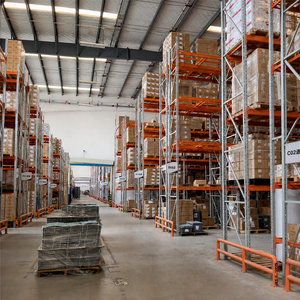
Back-to-back pallet racking consists of two single selective rack runs joined back-to-back using rigid steel row spacers. This dual-row coupling increases the total structural depth from a typical single frame (e.g., 1000mm or 1100mm) to a consolidated footprint of over 2200mm. The resulting increase in cross-aisle moment of inertia substantially enhances the frame's resistance to seismic overturning forces and asymmetrical forklift impact loads.
2. Aisle Space Halving Mathematical Principle
In a standard single-row layout, every single pallet rack line requires its own dedicated operating aisle for forklifts. By placing two rack rows back-to-back, two pallet locations share a single operating aisle. This simple geometric consolidation instantly reduces aisle floor consumption by up to 40% to 50% compared to single-row configurations, driving volumetric efficiency up to 65% of clear ceiling height.
Technical Comparison Matrix: Storage Racking Systems
| Racking Type | Selectivity (SKU Access) | Floor Area Utilization | Forklift Compatibility | Cost per Pallet Position |
|---|---|---|---|---|
| Back To Back Selective Rack | 100% Direct Access | 45% – 60% | Standard Counterbalance / Reach Truck | Lowest (Baseline 1.0x) |
| Double-Deep Pallet Rack | 50% Immediate Access | 60% – 70% | Specialized Pantograph Reach Truck | 1.3x – 1.5x |
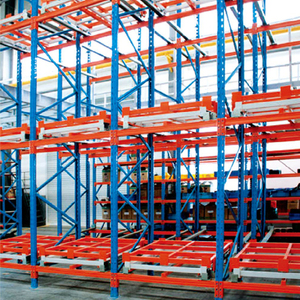
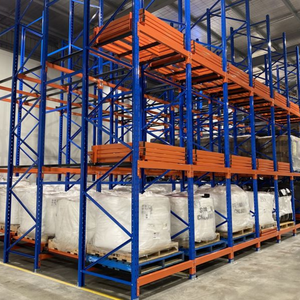
| Push-Back Racking (2-5 Deep) | LIFO (Last-In, First-Out) | 70% – 80% | Standard Forklift (Loads on Carts) | 2.2x – 2.8x |
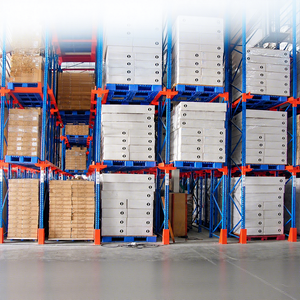
| Drive-In / Drive-Thru Racking | LIFO / Low SKU Diversity | 75% – 85% | Forklift Enters Frame Matrix | 1.8x – 2.2x |
| Automated Radio Shuttle Rack | High Density LIFO/FIFO | 85% – 92% | Automated Shuttle + Forklift | 3.5x – 4.5x |
Engineering Insight: Row Spacer Dimensioning & Fire Safety
Standard row spacers for back-to-back racking typically range between 200mm and 300mm in length. In facilities equipped with ESFR (Early Suppression, Fast Response) ceiling sprinklers, local fire protection codes (such as NFPA 13) mandate minimum vertical longitudinal flue spaces (typically 6 inches or 150mm net clearance) between back-to-back pallets to allow unhindered water penetration during thermal emergencies.
Future Procurement & System Development Trends (2026–2030)
As global supply chains face volatile land costs, labor shortages, and ESG carbon reduction mandates, warehouse pallet racking procurement is undergoing four paradigm shifts.
1. Synergy with AGVs & Autonomous Mobile Robots (AMRs)
Traditional back-to-back racking is being upgraded with precise laser-guided alignment reflectors and floor-anchored guidance rails. Procurement managers are increasingly requesting tighter frame tolerances (EN 15512 Class 400) to allow autonomous reach trucks and AMRs to operate seamlessly in narrow back-to-back aisles without human driver intervention.
2. Transition to High-Yield Cold-Rolled Q355B Steel
To reduce freight weight and total raw material consumption, top exporters like Rackzzszn are replacing legacy low-carbon Q235B steel with cold-rolled Q355B high-tensile structural steel (equivalent to ASTM A572 Grade 50). This transition provides up to 35% higher yield strength, allowing thinner profile gauges while maintaining or increasing load capacity.
3. Modular Conversion: Back-To-Back to Push-Back & Pull-Out
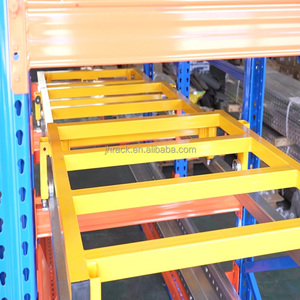
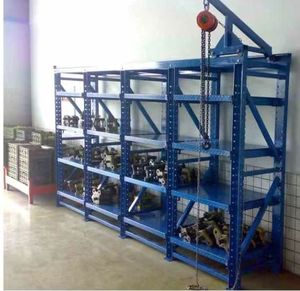
Forward-thinking fulfillment hubs are sourcing modular racking components that allow quick field upgrades. Standard back-to-back beam bays can be converted into 2-to-5 deep push-back cart systems or fitted with 1,000kg ergonomic pallet pull-out drawers (acting like heavy-duty cabinet drawers) to drastically increase picking speeds without replacing upright frames.
Rackzzszn Corporate Advantages & Manufacturing Strength
Rackzzszn Storage Equipment Co., Ltd. is South China’s premier industrial storage equipment OEM manufacturer, delivering reliable, custom-engineered warehouse solutions worldwide.
State-of-the-Art Production Facility & Spray Line
Covering over 20,000 m², our factory operates 80+ automated machines, including continuous high-speed roll-forming lines, robotic CNC beam welding units, and South China's longest continuous automatic powder coating spray line. We apply non-toxic, eco-friendly epoxy electrostatic powder coatings that withstand high-humidity and low-temperature cold-storage environments.
End-to-End Engineering & International Export Capability
With over 23 years of specialized export experience shipping 1,000+ containers per year to 60+ countries, Rackzzszn provides full project support. Our engineering team conducts initial structural site surveys, creates customized 2D/3D CAD layouts, performs FEA load strain analysis, provides container optimization packing, and sends installation guides or site engineers worldwide.
Frequently Asked Questions by Industrial Racking Buyers
Direct answers from our senior structural engineers regarding back-to-back rack design, floor slab requirements, and export logistics.
What is the exact aisle width required for a back-to-back selective pallet racking installation?
Aisle width depends entirely on the material handling equipment (forklift) operating in the building:
- Standard Counterbalance Forklifts: Require aisle widths between 3.5 meters and 4.2 meters.
- Reach Trucks (Moving Mast): Require aisle widths between 2.7 meters and 3.2 meters.
- Very Narrow Aisle (VNA) Turret Trucks / Articulated Trucks: Can operate in narrow aisles of 1.6 meters to 1.9 meters, dramatically boosting storage capacity.
Rackzzszn engineers review your specific forklift turning radius (AST - Right Angle Stacking Aisle) specs before designing row spacing.
How do row spacers contribute to the structural integrity of back-to-back racks?
Row spacers physically tie two adjacent upright frames together at regular height intervals (typically at node points where diagonal frame bracing intersects upright posts). This structural linkage prevents individual frame sway, distributes horizontal impact energy across both rows, and ensures consistent longitudinal flue spaces for fire sprinkler systems.
Why is site measurement and floor slab load capacity verification crucial before ordering?
Building architectural blueprints frequently differ from real-world site conditions. A column placement discrepancy of just 2 cm can prevent upright frames from fitting or block mandatory fire escape routes. Furthermore, heavy-duty back-to-back racks exert concentrated point loads through baseplates onto the concrete slab. We verify concrete slab thickness (typically minimum 150mm–200mm, C25/C30 grade concrete) and point load ratings (e.g., 5 to 10 tons per footplate) to prevent slab cracking or catastrophic settlement.
Can back-to-back pallet racks be safely utilized in sub-zero cold storage facilities?
Yes. However, low temperatures (down to -30°C in blast freezers) make standard carbon steel prone to brittle fracture. Rackzzszn utilizes structural Q355B steel grades with certified Charpy V-notch impact toughness and applies specialized low-temperature powder coatings and hot-dip galvanized finishes to prevent rust, micro-cracking, and coating flaking.
What export packaging and container loading protection does Rackzzszn provide?
Upright frames and beams are bundled with steel strapping, heavy-duty edge protectors, and waterproof plastic wrap to prevent scratching during ocean transport. Smaller accessories (baseplates, row spacers, safety pins) are packed in reinforced wooden crates or heavy-duty steel pallets, optimizing 40ft High Cube (40HC) container space utilization up to 98%.
How does Rackzzszn support international installation and assembly guidance?
Every order includes detailed 2D/3D assembly drawings, column anchoring maps, torque specifications, and step-by-step video installation guides. For large-scale distribution projects, Rackzzszn can dispatch experienced installation engineers directly to your site to supervise local assembly teams, execute final load testing, and provide safety inspection certificates.
Optimize Your Warehouse Density & Storage ROI Today
Send us your warehouse floor plan, ceiling height clearance, and pallet dimensions. Rackzzszn structural engineers will deliver a free 2D/3D CAD layout design and preliminary cost estimate within 24 hours.