1. Comprehensive Technical Overview: Two Way Shuttle Racking Architecture
In the modern paradigm of intralogistics and volumetric space optimization, the Two Way Radio Shuttle Racking System stands out as a high-density semi-automated storage breakthrough. Designed specifically for operations requiring intensive pallet throughput, high SKU concentration, and maximum floor cube utilization, two-way shuttle systems bridge the functional gap between fully manual selective pallet racking and fully automated ASRS (Automated Storage and Retrieval Systems).
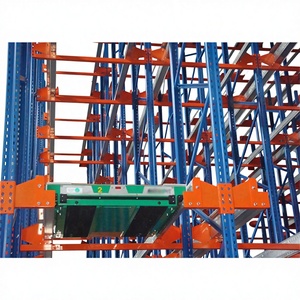
The system operates by integrating high-precision structural steel racking channels with an autonomous, battery-powered radio shuttle car. The shuttle vehicle travels independently along customized guide rails located beneath the pallet positions inside deep storage tunnels. Managed via a handheld radio frequency (RF) remote controller or integrated warehouse management system (WMS) tablet, the shuttle executes core commands: lifting pallets, transporting them along the channel, precisely positioning them, and retrieving them for forklift pickup at the outer aisle face.
LiFePO4 Power Systems
Equipped with heavy-duty Lithium Iron Phosphate batteries providing up to 8-10 hours of uninterrupted operational cycle time with rapid 3-hour fast charging.
Multi-Sensor Anti-Collision
Integrated laser distance sensors, photoelectric sensors, and mechanical safety bumpers eliminate track derailment risk and prevent physical collisions.
Operational Temperature Adaptability
Engineered for harsh thermal environments ranging from ambient dry goods warehouses (+45°C) to deep frozen cold storage rooms down to -30°C.
Technical Component Breakdown
- Structural Steel Upright Frames: Formed from high-tensile Q235B or Q355B cold-rolled steel coils, featuring perforated teardrop or omega profiles for micro-adjustable beam levels in 50mm or 75mm increments.
- Precision Guide Rails: Galvanized or powder-coated structural steel tracks designed with dual functionality: guiding the shuttle car wheels and supporting full pallet loads up to 1,500 kg per position.
- Autonomous Two-Way Shuttle Vehicle: Low-profile robotic cart containing brushless DC motors, hydraulic lift mechanisms, optical positioning sensors, and wireless communication cards.
- Safety Stoppers & Rail End Buffers: Heavy-gauge welded steel stops installed at both ends of every channel to physically prevent accidental shuttle ejection during rapid travel.
2. Strategic Relevance for Istanbul & Marmara Industrial Hubs
As Turkey’s primary commercial epicenter, Istanbul occupies a unique geopolitical position connecting European and Asian supply chains. Industrial zones across the Marmara region—including Tuzla Organized Industrial Zone (Tuzla OSB), Gebze, İkitelli, Hadımköy, Dilovası, and Çerkezköy—face unprecedented challenges in logistics management:
- Extreme Industrial Real Estate Costs: Land prices in Istanbul industrial zones have surged, forcing warehouse managers to maximize vertical storage density ("cube utilization") rather than expanding horizontal square footage. Two-way shuttle racking increases warehouse capacity by 70% to 200% compared to standard selective racking.
- Marmara Seismic Zone Compliance (TBDY 2018): Under the Turkish Building Seismic Code (TBDY 2018) and Eurocode 8, high-bay racking systems in Istanbul must withstand severe lateral seismic forces ($S_{ds}$ acceleration spectrum). Our shuttle rack engineering incorporates heavy-duty diagonal bracing towers, oversized baseplates, and chemical anchor bolts rated for dynamic seismic loads.
- High-Throughput Cold Chain & Food Logistics: Port hubs such as Ambarlı Port and Haydarpaşa Port handle massive volumes of perishable foods, pharmaceutical products, and agricultural exports. Shuttle racking drastically reduces cold room volume loss, minimizing electrical power consumption for refrigeration compressors.
3. Quantitative Matrix: Two-Way Shuttle vs. Alternative Racking Technologies
To assist warehouse directors, supply chain consultants, and industrial engineers in Istanbul when evaluating capital investments (CAPEX), the table below highlights key operational parameters across industrial racking choices:
| Storage System Type | Floor Space Efficiency | Operational Selectivity | Forklift Aisle Requirement | Seismic Resilience | Risk of Rack Collision |
|---|---|---|---|---|---|
| Two-Way Radio Shuttle Racking | Extreme (85%–90%) | Batch / Channel Selective (FIFO/LIFO) | Minimal (Outer Aisle Only) | High (Rigid Channel Bracing) | Very Low (Forklifts Do Not Enter Channels) |
| Drive-In Racking | High (65%–75%) | Strict LIFO Only | Forklift Drives Inside Racks | Moderate (Requires Top Bracing) | High (Frequent Upright Strikes) |
| Selective Pallet Racking | Low (35%–45%) | 100% Direct Access | Wide (3.5m – 4.5m) | Moderate | Moderate (Exposed Uprights) |
| VNA (Very Narrow Aisle) Racks | Moderate-High (55%–65%) | 100% Direct Access | Ultra-Narrow (1.6m – 1.8m) | High | Low (Turret Truck Wire Guided) |
| Gravity Pallet Flow Racking | High (75%–80%) | Strict FIFO Only | Loading & Unloading Aisles | Moderate | Low (Roller Brake Controlled) |
4. Engineering & OEM Strengths: Why Choose Rackzzszn
As an industry-leading warehouse racking manufacturer with over 23 years of specialized experience, Rackzzszn Storage Equipment Co., Ltd. delivers world-class manufacturing standards to distributors, contractors, and end-users in Istanbul and worldwide.
50,000 Tons Annual Production
Our 20,000 m² state-of-the-art facility features automated cold-roll forming lines, laser tube cutting machines, and robotic welding stations ensuring millimeter precision.
SGS & CE Audited Quality
Every structural upright and beam is certified according to international standard ISO9001 and EN 15512 static design specs, guaranteeing load capacity safety limits.
South China's Longest Powder Line
Equipped with an advanced automated electrostatic powder coating system supporting multi-color application in a single pass for extreme corrosion resistance.
From initial structural FEA (Finite Element Analysis) stress testing to 3D CAD architectural layout drawing, our team of dedicated structural engineers works directly with Turkish procurement agents to deliver customized OEM/ODM turnkey projects. We handle complete sea-freight packing in steel-banded bundles with protective plastic film to guarantee container shipment integrity upon arrival at Turkish sea ports.
5. Frequently Asked Questions (FAQ) for Procurement in Istanbul
How does a Two Way Shuttle system comply with Turkish Seismic Building Code (TBDY 2018)?
Can Two Way Shuttle systems operate in both FIFO and LIFO modes?
What shipping logistics and customs support do you provide for imports into Turkey?
What battery maintenance and spare parts support are included with the shuttle carts?
Why is on-site structural measurement essential before final rack fabrication?
6. Project Lifecycle: From Initial Inquiry to Commissioning
Executing a successful shuttle racking installation requires disciplined project management. Our standardized 4-stage engineering methodology guarantees seamless implementation:
- Stage 1: Site Survey & SKU Profiling: We analyze your floor plan, ceiling clear height, forklift turning radii, pallet specifications (1200x1000mm, 1200x800mm, Euro-pallets), load weights, and throughput cycles per hour.
- Stage 2: Structural Engineering & FEA Simulation: Engineers formulate 2D CAD layout drawings and 3D structural simulations, verifying beam deflection ratios ($\le L/200$) and column stability under combined dead, live, and seismic load combinations.
- Stage 3: Automated Precision Manufacturing: Raw Q235B/Q355B steel coils are cold-rolled, perforated, robotic-welded, pre-treated, and powder-coated under stringent ISO9001 quality supervision.
- Stage 4: Sea Freight & Installation Guidance: Racking components are container-packed with protective wrap and exported. We provide step-by-step assembly drawings, video tutorials, and optional overseas installation engineering supervision.
Ready to Upgrade Your Istanbul Warehouse Storage Capacity?
Consult with our senior logistics structural engineers today for a complimentary 2D/3D racking layout plan, seismic load assessment, and competitive factory-direct price quotation.
Contact Us